
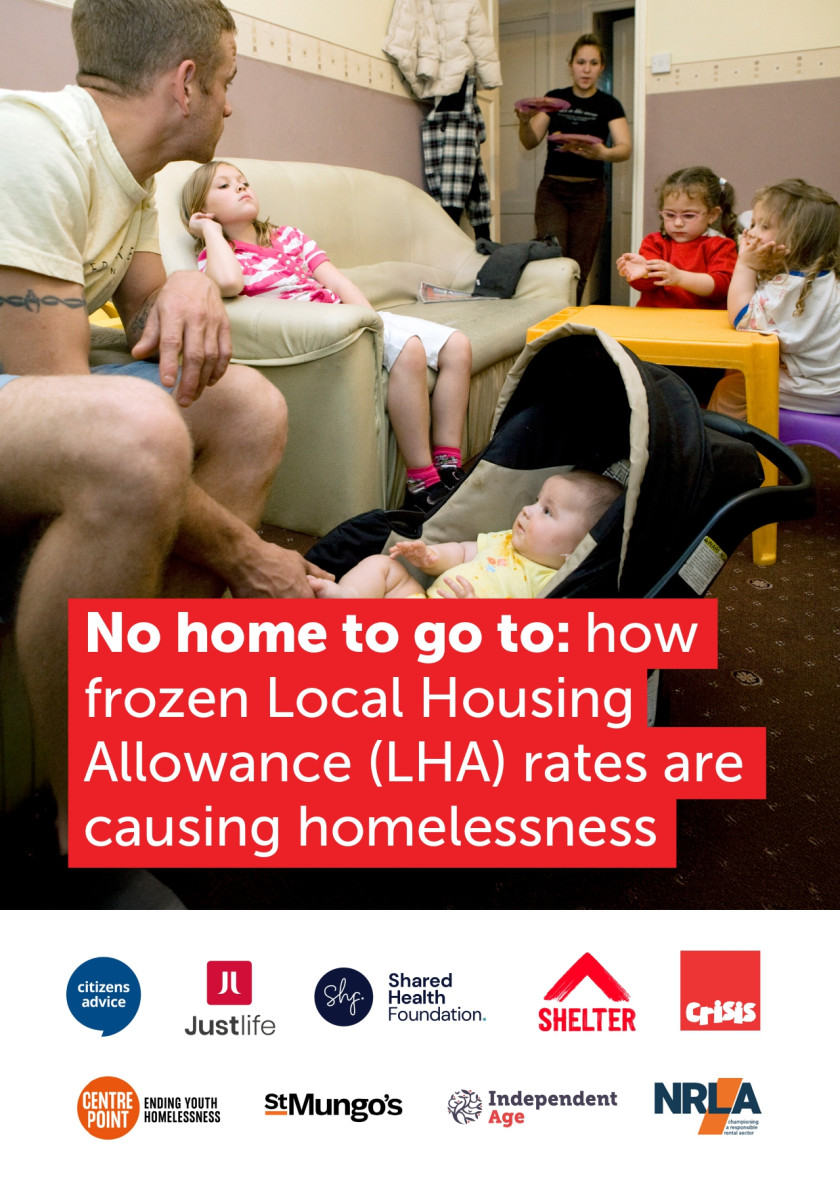
There is a direct link between the Local Housing Allowance (LHA) rate freeze and what is going on with Temporary Accommodation. With ever increasing numbers of people being pushed into TA, getting stuck there for longer, and at ballooning costs to local authorities and the tax-payer, it is worth asking why.
There are currently 134,210 households, including 176,130 children, living in temporary accommodation (TA) in England. The cost of this to local authorities was £2.8 billion in 2024/25, a 25% increase on the previous year. Housing used as TA ranges in quality, but much of it is far from fit for purpose.
A recent Freedom of Information request has revealed that more than 700 people died in TA in London between 2022-23 and 2024-25, many of them children. Further, a third of TA placements are out-of-area, causing severe disruption to people’s lives. With severe blockages in the system, these placements continue to rise, as local authorities have few other options.
The freezing of the LHA rate represents one such specific and substantial blockage; un-affordability pushes people into temporary accommodation, while making it hard to leave once there.
Research has consistently shown a link between diminishing welfare support, specifically reforms and freezes to the LHA rate, and rising numbers of people accessing temporary accommodation or remaining in it for longer. Conversely, when rates have been uplifted in the past, services have highlighted noticeable dips in the numbers of people accessing housing-cost related support.
Frozen rates as a driver of homelessness
Local Housing Allowance is meant to help low-income households afford the cheapest 30% of private rented homes in their area. The LHA rate has been frozen several times, most recently in April 2024. The same year, the HCLG Committee warned of ‘widespread agreement’ in the sector that the decision to freeze LHA rates would lead to an increase in homelessness. According to the Institute for Fiscal Studies, “since the year to September 2023, on which LHA rates are based, UK rents have grown by approximately 19%”. In the same time period, the number of households in TA has gone up by 25,000.
The increase in people turning to temporary accommodation can’t be explained by a single policy decision; a broken asylum system, domestic violence, and severe lack of social and affordable housing, are all contributing factors. However, reducing state support to pay rents has a direct and immediate impact. Support on the LHA rate now covers rent on only 1.9% of homes, and both rent arrears and evictions by bailiff have reached an all time high. The recent ban on section 21 notices will help address evictions, but with less money to pay rent, more people will be forced out of their homes regardless.
On top of creating new homeless households, the freeze is keeping people stuck in TA for longer. Tens of thousands of households are currently in TA who have been there for 5 or more years, up from before the rate freeze. Joseph Donohue from the Greater Manchester Combined Authority, in evidence to the HCLG Committee, specifically tied the frozen LHA rates to the lack of “ability of councils to move people from temporary accommodation into a permanent home” .
The human cost
A stay in temporary accommodation, for any length of time, can be incredibly harmful for people. There is plenty of evidence to suggest that much TA is in substandard condition, and that this impacts livelihoods. Healthy life expectancy in the UK is now falling, a watershed moment that has been linked directly to unstable and poor-quality housing. Temporary accommodation often represents the very bottom of the housing market in terms of both.
We consistently hear about poor conditions from people with lived experience. In 2023, through the APPG for Households in TA, we published responses to a call for evidence on TA conditions. People with lived experience of TA, as well as those that support them, revealed poor maintenance, lack of basic amenities, accessibility issues, and a prevailing sense of unsafety as common issues in temporary accommodation. In 2025 we published A Better Vision for Temporary Accommodation, focusing on solutions to the current crisis. Again, uncleanliness, damp and mould, poor security, overcrowding, and a lack of amenities were among the most common themes.
Most recently, we submitted feedback from our Temporary Accommodation Action Groups (TAAGs), as evidence to the HCLG Committee inquiry on housing conditions in England.
Our TAAGs - which are cross-sector collaborative groups of stakeholders, aimed at driving change around TA locally - highlighted many of the same issues. 81% of TAAG respondents said that serious hazards, overcrowding, poor maintenance and a lack of amenities, were either moderately or very prevalent in TA.
It’s not just the physical state of temporary accommodation that impacts residents. Recently we’ve seen a spike in the already high numbers of households living in TA away from their local area. There are now 43,030 households living away from their support services, their friends and family, and their communities. Often seen as a solution when in-borough TA is deemed unsuitable, an out of area placement can itself be incredibly damaging. People are struck off GP lists, children miss weeks or months worth of school, and households wrack up large debts travelling to and from their original local authority area.
The impact of unsuitable placements is devastating, and can become worse the longer people stay in temporary accommodation. In a survey of Justlife clients in 2013, 94% reported mental health issues. According to Homeless Link, 73% of people who are homeless face physical health problems. The longer people remain without a home, the more health issues are exacerbated for people.
Are we saving money?
The HCLG Committee has suggested that there is a false economy in the latest freeze to LHA rates; we may save on housing benefit in the short-term, but accrue large financial costs in the future, both in the form of direct TA costs from an increase in people accessing the service, but also less visible costs incurred through the destabilisation to people’s lives caused by a period of homelessness. Some of these costs will come back to the DWP in the form of long term reliance on benefits. This false economy has been demonstrated through analysis of the 2011 reforms to LHA, when it was moved from the 50th to 30th percentile. Researchers from the University of Warwick said of the cuts at the time:
“The direct fiscal savings to the central government for lower housing benefit payments were substantially offset by increase in the demand for temporary accommodation…We estimate that, on average, for each pound of implied fiscal savings accruing to the central government due to the cuts, local government expenditures on homeless prevention increased by 53 Pence.”
As the pressures mount, and the costs of the increasingly relied upon nightly-paid TA have skyrocketed since 2011, the shift of the financial burden - from central government to local authorities - has increased. This has now reached breaking point for local authorities. In addition, there are less visible costs to the economy caused by an increase in the reliance on TA. These costs will come back to central as well as local governments. Beyond the personal trauma, there is the added pressure on the NHS (poor housing has been estimated to cost the NHS in England £1.4 billion each year), and the impact on people’s ability to contribute to the economy.
All these factors should be considered in our economic thinking. Without looking at the long- term effects of LHA cuts, and the subsequent rises in homelessness and the costs that increasing reliance on TA incurs to different departments, locally and nationally, we are ruining lives at great financial cost to the country.
The good news is that the current trend of increasing costs, personally and financially, are not inevitable. Unfreezing LHA rates would meaningfully impact many people’s ability to continue paying rent in the private sector, thereby preventing their need to rely on temporary accommodation. It would also help many people currently stuck in TA to afford to move back into the Private Rented Sector. Not only does this benefit the individual, preventing potential long-term trauma from a period of homelessness; it benefits us all by reducing costs elsewhere in the system and improving people’s ability to contribute to the economy.
‘This blog is an edited version of a chapter that appears in a joint report between Justlife and a coalition of homelessness, housing, health, and advice organisations, on the impact of the ongoing Local Housing Allowance (LHA) freeze on poverty and homelessness’.
Read the report.


