
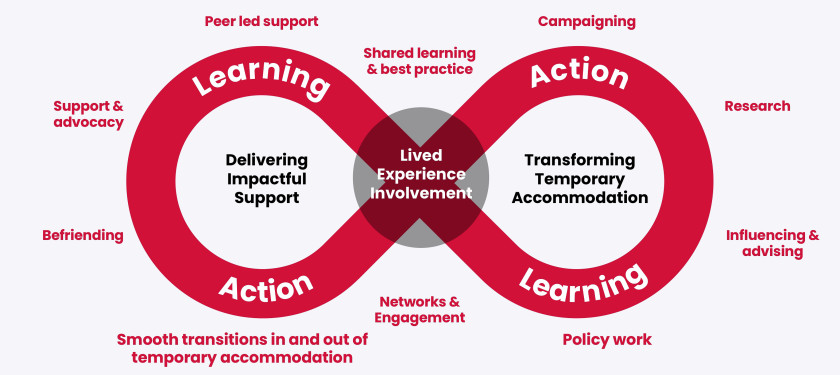
This year, we published our 2026–30 strategy, setting out our vision, values and ambitions for the next four years as we work towards making stays in temporary accommodation short, safe and healthy. At the heart of this strategy is our commitment to meaningfully centre lived experience in shaping our decisions and services, as well as our campaigning and influencing work.
Over the past year, we have worked with 179 people with lived experience through our participation work. This means that more people with lived experience have contributed to shaping our work than there are contracted staff members at Justlife, demonstrating the scale of lived experience involvement across the organisation and the breadth of perspectives informing systems locally and nationally.
Alongside this, we have been strengthening the foundations for meaningful participation, developing guidance and approaches to help ensure that involvement is diverse, equitable, inclusive and trauma-informed.
We are proud to see lived experience becoming increasingly embedded across the organisation, extending beyond individual co-production projects. This includes ongoing work through our Temporary Accommodation Action Groups (TAAGs), All-Party Parliamentary Group (APPG) and Transforming Temporary Accommodation Programme, alongside lived experience-led projects such as Common Ambition, peer and community research, and our newly formed Lived Experience Campaign Group (LECG).
Together, these different strands of work create opportunities for people with lived experience of homelessness to meaningfully shape services, research, policy and campaigning, as well as how we work as an organisation.
Here we share some examples of lived experience in action across Justlife over the past year.
We have developed and updated guidance to support a more diverse, equitable and inclusive approach to lived experience participation. Drawing on learning from lived experience engagement and consultation with colleagues across the sector, this work uses an intersectional lens to accessibility and outlines how we can reduce barriers to participation and ensure a wider range of experiences and perspectives can shape our work. As well as informing our own practice, we hope these resources will contribute to wider sector learning and support stakeholders to develop their approaches to lived experience participation.
It has resulted in a range of practical guidance, policies and definitions, including:
Lived Experience Recruitment and Engagement Guide:a practical resource pulling together approaches to recruiting and engaging people with lived experience in safe, inclusive and effective methods.
Involving Families in Participatory Projects Guidance:a guide on reducing barriers for families, looking beyond childcare provision to consider how participation can better accommodate family life and ensure families are meaningfully included.
Short-Term Engagement Guidance:guidance for involving people with lived experience in short-term or one-off activities, helping staff to ensure that participation is meaningful, even when there is less time to build trusting relationships.
Justlife Lived Experience Ethics Policy:updated to include cultural accessibility, strengthening our commitment to embedding anti-racism in our co-production and participation work.
Our TAAGs bring together residents, statutory services, community and voluntary organisations and housing providers to drive positive change for people living in temporary accommodation at a local level.
Lived experience is fundamental to the structure and success of our TAAGs, with people with lived experience helping to identify priorities, shape action plans and contribute to decision-making. This approach has led to a range of local improvements, including practical resources such as local support leaflets, a standards and quality TA charter and rewritten temporary accommodation offer letters, making information more accessible and improving safety and health in Temporary Accommodation for residents.
Our TTAP programme is a national initiative to improve the safety, quality and effectiveness of TA across England, with lived experience embedded throughout the three testing hubs in Bristol, Nottinghamshire and Westminster and through a dedicated lived experience member on the Programme Board.
The Board member has helped strengthen lived experience involvement across the programme, including revising the TTAP Terms of Reference, attending the formative TTAP Coalition meeting and co-designing training and support for the testing hubs. This helps ensure that the programme is shaped by the expertise of people with lived experience, leading to more impactful change that is responsive to the realities of TA.
In July 2026, we established a 6-month pilot LECG, formed of three people with first-hand experience of staying in Temporary Accommodation from Brighton, London and Manchester; alongside two facilitators.
The group is developing a lived experience-led campaign supporting our vision to make stays in temporary accommodation shorter, safer and healthier, creating a new route for lived experience to directly shape our campaigning and influencing work.
Common Ambition brings together people with lived experience of Multiple Compound Needs (MCN), services and commissioners to improve system and service delivery and outcomes for people experiencing multiple compound needs. Over the past year, lived experience has shaped work across Brighton & Hove and West Sussex, including:
Strategy and systems: influencing the Homelessness and Rough Sleeping Strategy and Supported Accommodation Strategy, contributing to the street outreach tender, and developing a joint working protocol to strengthen collaboration across services.
Training and practice development: developing GP training and exploring how support for women who use substances could be improved across the county.
Resources: creating a map of women’s services, developing a lived experience guide to navigating recovery, and contributing to the development of the Health and Support Card.
Research: working with universities to help ensure research involving people with MCN is safe, inclusive and trauma-informed.
In July 2026, the Lived Experience and Participation Team, Common Ambition and the APPG Influencing Coordinator brought people with lived experience of homelessness to Parliament to champion the role of lived experience in shaping policy.
We shared our experiences of co-production and systems change directly with MPs and staff from the Ministry of Housing, Communities and Local Government (MHCLG), demonstrating the principles that underpin meaningful participation in practice. Following the session, MHCLG invited us to continue sharing this learning, with the aim of influencing temporary accommodation policy and practice.
These examples showcase how lived experience is becoming increasingly embedded across different parts of Justlife, from organisational policy and practice to local service improvement, research, national programmes and campaigning. They demonstrate that people with lived experience can make a meaningful contribution to shaping services, research, policy and wider systems when given the right opportunities, support and influence. We believe lived experience should be recognised as a form of expertise and embedded meaningfully wherever decisions are being made about people’s lives. We will continue to build on this work and share what we learn to support wider change across the sector.
For Justlife guidance and resources on how to involve people with lived experience in your work, visit our Lived Experience webpage.
You can also explore our Lived Experience Padlet, which brings together resources from across the sector on Lived Experience Payment, Trauma-Informed Practice, Reflective Practice, Power and Participation, Participatory Approaches and more.


